
Can You Render in Winter? The Honest Answer for Cornwall
People ask us this a lot, usually because they're trying to get work done before Christmas or they've got a project that's run on into November. The short answer is: it depends on the temperature, and in Cornwall that question mostly answers itself.
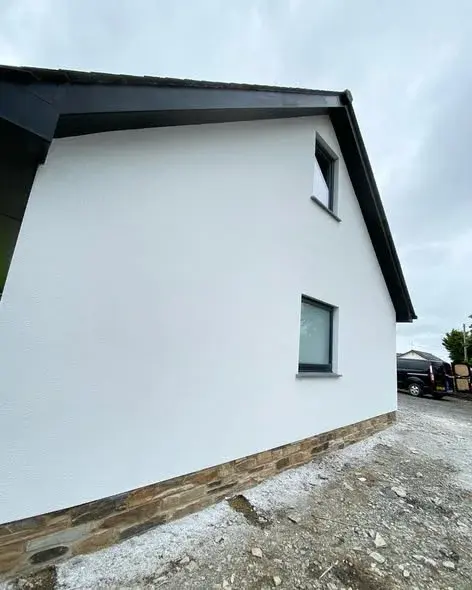
Temperature limits for rendering
Most render manufacturers specify a minimum application temperature of 5°C, and this isn't a rough guideline — it's a hard limit based on the chemistry of how cementitious and polymer-modified renders cure. Below 5°C the chemical reactions that harden the render slow down dramatically. Below freezing they stop entirely, and any moisture in the uncured render will freeze, expand, and disrupt the bond structure as it forms.
The temperature requirement applies not just during application but for a period afterwards while the render cures. Most manufacturers specify that temperatures must remain above 5°C for at least 24–48 hours after the render is applied. So even if it's 8°C when you put the render on, if there's a frost forecast that night, you have a problem. A render that looked fine on application can fail completely if it freezes during the first 24 hours.
The wall temperature matters too, not just the air temperature. A wall that's been exposed to cold for weeks can hold a surface temperature well below the ambient air temperature. Applying render to a wall at 2°C in 8°C air is still applying it to a cold surface.
Frost risk and why it matters
When render freezes during curing, water in the mix expands as it turns to ice. This disrupts the bond between the render and the substrate and also disrupts the internal structure of the render itself. The result — once it thaws — is render that's friable, powdery, has poor adhesion, and will likely delaminate within the first season. You can't repair frost-damaged render by waiting for it to warm up. Once it's gone wrong, it comes off.
The problem isn't always visible immediately. Fresh render can look perfectly fine after a frost and then begin to fail when it's subjected to rain or movement in the spring. This is one reason why winter render failures sometimes don't show up until months after the work was done — and why a contractor willing to render in December and January without any protection measures is someone to be cautious about.
Rain and wet weather
Rain during application is a separate issue from cold. Heavy rain while render is fresh and uncured can wash the surface, cause runs, and in the worst case wash material off the wall entirely. Light drizzle after the render has firmed up (usually after a few hours, depending on conditions) is generally fine — some manufacturers actually say their products can tolerate rain once the initial set has taken.
In Cornwall, the issue isn't rain per se — it rains a lot here year-round and you'd never work if you stopped for every shower. It's the combination of cold, persistent rain, and no drying periods that makes the winter months particularly difficult. November through January tends to deliver sustained cold fronts with heavy rain and limited dry windows, which means application is risky even when the air temperature is marginally above 5°C.
Silicone render in cold weather
Silicone render has the same minimum temperature requirements as other systems — typically 5°C during application and for the following 24–48 hours. The polymer content in silicone systems can make them marginally more tolerant than straight sand-and-cement in mild cold, but manufacturers are clear that the 5°C minimum still applies. The silicone component doesn't prevent frost damage; it just improves the cured product's water-repellence once it's fully set.
Some contractors will tell you silicone render is “fine in winter” because of its polymer content. That's not accurate. Check the data sheet of any silicone render product and you'll find the same 5°C minimum. The polymer improves long-term performance, not cold-weather application.
Lime render in cold weather
Lime render is if anything more temperature-sensitive than cement-based systems. Hydraulic lime relies on a slow carbonation process to cure — it takes in CO2 from the atmosphere and slowly hardens over weeks and months. Cold dramatically slows this process. Applying lime render in temperatures below 5°C, or where frost is possible in the weeks after application, is strongly inadvisable. The British Lime Association recommends against applying lime render when temperatures are at or below 5°C and for the foreseeable period afterwards.
Lime render's extended curing period (it should ideally be protected and damped down for several weeks after application to slow the curing and prevent surface crazing) makes it particularly ill-suited to the short-window, uncertain-weather conditions of a Cornish winter. It's a spring and autumn material in this climate. We wouldn't apply lime render in Cornwall between November and February without very good reason and significant protection measures.
Internal plastering in winter
This is the good news for anyone whose project runs into winter: internal plastering is not affected by outdoor temperature in the same way. As long as the building is weathertight, has some heat in it (not freezing cold), and adequate ventilation for drying, internal skim coats and multi-finish plaster can be applied year-round without issues.
The drying time for internal plaster does extend in cold conditions — a skim that would dry in 24 hours in summer might take 36–48 hours in January with limited heating. But the work itself is fine, and the result is the same. If you're renovating and want to get internal rooms plastered over winter before tackling the external rendering in spring, that sequence makes perfect sense and we'd be happy to work to it.
Best booking windows in Cornwall
In our experience working out of Bude, the reliable application windows for external rendering are:
Good months
- March – April (spring, pre-tourist)
- May – June (best conditions)
- September – October (autumn window)
- November (possible, needs close weather watching)
Avoid for external
- January – February (frost risk too high)
- December (unreliable, short days, cold)
- Any week with sub-5°C overnight forecasts
July and August are fine weather-wise but get busy fast — Cornwall in summer means access can be harder, local supply chains get stretched, and we tend to be fully booked by April for the summer. If you want a summer slot, the best time to call is late winter.
Our honest answer
We won't render externally in January or February in Cornwall without a heated enclosure, which is a significant additional cost rarely justified on domestic jobs. The risk of frost damage to the curing render — and the cost of having to strip it and start again — outweighs any benefit of getting the job done in winter. We'd rather wait and do it right.
Winter is not dead time though. It's a good period for quoting jobs, planning colour choices, ordering materials, and getting your booking in for the spring. If you've got a project in mind for 2027 or early spring, now is the time to get in touch — the March–May window fills up well before Christmas most years.
And be wary of any contractor willing to guarantee a winter render job without being clear about the temperature constraints. It's not that it's impossible in every week of winter — a mild run of weather in November can be fine. But anyone who doesn't raise the temperature question at all probably isn't thinking carefully enough about what happens if it drops overnight.
Got a job in mind?
Call us on 07761 735022 or message on WhatsApp. Free quotes, no pressure.
Related articles
Written by the PureRend team — plastering and rendering specialist in Bude, Cornwall.