
Why Coastal Properties in Cornwall Need Silicone Rendering
We've rendered properties from Bude down to Widemouth Bay and across to Bideford, and the pattern is always the same: the closer to the coast, the harder the weather is on render. If you're on or near the north Cornish coast and you're using anything other than silicone, you're going to be doing it again in ten years.
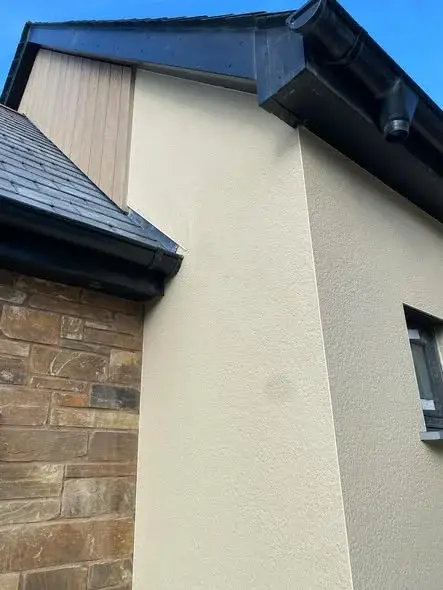
What coastal conditions actually do to render
Cornwall's north coast faces the full force of the Atlantic. Properties around Bude, Widemouth Bay, Crackington Haven and Bude Haven deal with conditions that genuinely don't compare to what you'd find twenty miles inland. The driving rain is relentless from October through March. The wind carries salt off the sea continuously. And the temperature swings repeatedly across zero degrees throughout winter.
These three things — salt, moisture, and temperature cycling — are the enemies of any render that isn't specifically engineered to handle them. Standard sand-cement render wasn't. That doesn't mean it fails immediately, but it does mean it ages badly in coastal exposure, and it means the maintenance burden is significantly higher than it would be inland.
Salt spray: the main culprit
Salt-laden air is corrosive to porous materials. When salt water is drawn into a cement render, it deposits salt crystals inside the pores of the material as the water evaporates. Those crystals expand as they grow, and the process is called efflorescence and salt crystallisation. Over time it breaks down the render from the inside, causing a characteristic crumbling, spalling surface. You see white staining on the wall first, then powdering, then sections coming away.
The closer you are to the sea, the faster this happens. On properties directly overlooking the beach at Widemouth, we've seen traditional painted render that was noticeably damaged within five to eight years of application. It's not poor application in those cases — it's the exposure. The system simply isn't suited to the environment.
Salt corrosion also attacks the bonds between coats in a multi-coat system. If water can get in behind the topcoat and the basecoat via any crack or joint, salt crystallisation can separate the layers entirely, causing large sections to delaminate. We've stripped a fair amount of coastal render where this has happened — the whole façade needing to come off because the layers have parted company.
Freeze-thaw cycles
Cornwall doesn't get prolonged hard frosts the way the north of England does, but it does get repeated overnight freezes from November through February. The wet Atlantic air means the render is saturated going into those freezes. Water expands as it freezes, and if that expansion happens inside a rigid cement render, something has to give — usually hairline cracks at first, then wider ones as the cycles repeat over the years.
It's not dramatic. You don't see it happen. But by year eight or ten on an exposed Cornish property with cement render, the cumulative effect of dozens of freeze-thaw cycles shows up as a map of fine cracks across the surface. Water gets into those cracks, freezes again, and widens them. Once water is getting behind the render, the process accelerates.
Why standard cement render fails
Traditional sand-cement render has two properties that work against it in coastal exposure: it's porous and it's rigid. Porous means it absorbs water. Rigid means it can't accommodate the thermal movement and the expansion pressure without cracking. Both of those things matter on the north Cornish coast.
Paint on top of cement render doesn't solve the problem. Paint breathes in one direction — it can trap moisture inside the wall, which actually makes the freeze-thaw damage worse. We regularly see painted cement render on coastal properties where the paint is bubbling and peeling because moisture is trying to escape from behind. The wall is wetter than a bare render would be because the paint has stopped it drying out. Repainting every three to five years becomes the norm, and the underlying render still degrades.
Why silicone render handles it
Silicone render solves both problems. The silicone polymers make the surface hydrophobic — water beads and runs off rather than soaking in. On a coastal property, that means rain washes the surface clean rather than driving into it. Salt spray sits on the surface and gets washed off rather than working its way into the pores. The substrate stays drier.
Silicone render is also flexible. It can accommodate the minor thermal and structural movement in a wall without cracking. That flexibility is what makes it different from monocouche or traditional cement render on a building that moves even slightly. Hairline cracks simply don't form the same way. The system closes up rather than opening.
And because the surface repels water rather than absorbing it, algae and moss have much less purchase. The wet, shaded north-facing walls of coastal properties are notorious for green algae growth on traditional render. On a silicone finish, the surface dries faster and the algae simply can't establish. You still get some growth over five to seven years, but it's a fraction of what you'd see on cement render.
What we see on north Cornish jobs
A lot of the work we do in Bude and the surrounding area is remedial — stripping failed render off coastal properties and starting again properly. The pattern is almost always the same: someone put the cheapest system on, it looked fine for a few years, then the salt and the wet winters caught up with it. By the time the customer calls me, sections are loose, there's moisture getting into the wall behind, and the internal walls are showing damp patches.
The strip-back and reinstatement costs significantly more than doing it right the first time. When we price a coastal job now, we always recommend silicone on the topcoat, and we use a breathable basecoat that won't trap moisture. On exposed elevations we also recommend a more generous render thickness. The extra cost over a cheaper system is a few hundred pounds on most properties. Over twenty years it's a very different picture.
How often to soft wash a coastal render
Even on silicone render, we recommend a soft wash every four to six years on properties within a mile of the coast. The rain does a reasonable job of washing the surface down, but north- and west-facing walls in sheltered positions can accumulate algae more persistently. A soft wash with a dilute biocide kills the algae and resets the surface. It keeps the render looking clean and prevents any organic matter building up that could retain moisture.
Never pressure wash silicone render — or any render. High-pressure washing strips the surface texture and can force water behind the system at vulnerable points. Low-pressure, the right chemical, done properly. That's what extends the life to the 25-plus year mark.
Our honest verdict
If your property is anywhere near the Cornish coast, silicone render is not a premium option — it's the baseline. The Atlantic weather doesn't give you the option of running a standard system and expecting it to last. We've seen too many coastal properties that needed remediating within a decade because the wrong system was used the first time.
The cost difference between silicone and a cheaper system is genuinely modest on a per-square-metre basis. The difference in performance over 20 years on a coastal property is not modest at all. For anyone in Bude, Widemouth Bay, Bideford or anywhere within a reasonable distance of the sea — silicone, always.
Got a job in mind?
Call us on 07761 735022 or message on WhatsApp.
Related articles
Written by the PureRend team — plastering and rendering specialist in Bude, Cornwall.