
How Much Does Rendering Cost in Cornwall?
Last updated:
One of the most common questions we get asked — and the honest answer is that there's no fixed price list. Every property is different. What we can do is explain exactly what pushes a render quote up or down, so you know what you're paying for before we ever visit.
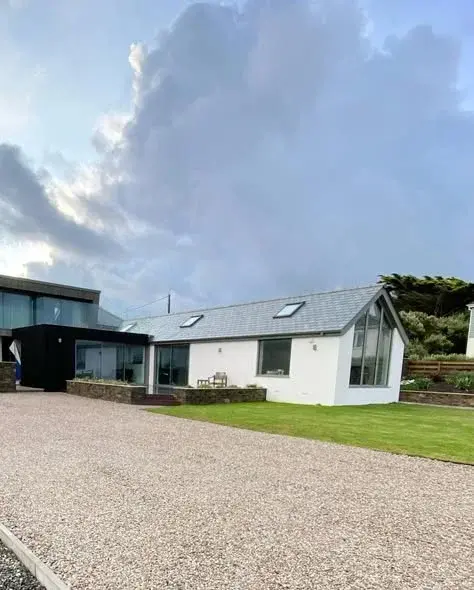
What drives the price
We don't publish a price list. Render can't be priced accurately from a chart or a phone call — the cost depends on the factors below, which only show up on a proper site visit. Anyone quoting a firm figure without seeing the job is guessing.
Two houses on the same street can come in very differently once you account for access, the condition of what's already on the wall, the amount of detail around windows and corners, and the render system that's right for the property. The sections below walk through each of the things that move a quote — so when you get a price from us, you understand exactly what's behind it.
Scaffolding and access
This is the one that catches people out. Scaffolding is a significant cost that's separate from the render itself, and on most two-storey houses it's a meaningful part of the job. We always quote scaffolding upfront and itemise it separately so there are no surprises.
On awkward sites — back gardens with poor vehicle access, terraces with tight street parking, or houses on steep slopes around Boscastle and Tintagel — access charges can creep higher. Sometimes a tower scaffold works for single-storey side returns and shaves cost off; on a full house elevation it almost never does.
Condition of the existing substrate
If the existing render is sound, we can work on or around it. If it's blown, cracked, or has failed in sections, it needs to come off first — and hacking off old render adds labour time. We always check this during the site visit and price it in.
On 1960s and 70s pebbledash properties (very common across North Cornwall), the question of whether you can render over the existing finish or have to strip back is a big variable in the final price. There's a separate article on that — see can you render over pebbledash?
Coastal location
Properties close to the coast — Bude seafront, Widemouth Bay, Crackington Haven, Crooklets — often need a more robust system. Silicone render handles salt-laden air and driving rain far better than standard cement. It costs a bit more upfront but lasts significantly longer in coastal conditions. It's usually the right call.
We see plenty of cement-rendered houses within 500m of the sea where the surface has crazed and biological growth has set in within a decade. A good silicone system in the same exposure can still look fresh after 20 years with only a soft-wash every few years.
Property size and complexity
A simple box-shaped bungalow is straightforward. A Victorian terrace with bay windows, decorative cornices, and complex reveals takes considerably longer. Intricate detailing costs more because it takes more time to get right — clean lines around stone heads, neat returns into reveals, properly bedded mesh into corner beads.
As a rough rule, every dormer, every chimney breast, and every awkward junction adds time. That's why a rendered surface area on its own doesn't tell the whole story — the perimeter and the detail count just as much as the square metres.
The render system you choose
Silicone render costs more than monocouche, which costs more than plain sand and cement. For exposed coastal properties in Cornwall, we usually recommend silicone — it pays for itself over time in reduced maintenance. For sheltered new-build extensions inland, monocouche can be the smarter buy.
Full breakdown in the materials guide: silicone render vs monocouche.
Why the cheapest quote isn't always best value
We see the results of cheap render jobs regularly. The tell-tale signs: patches failing within 2–3 years, algae returning quickly, cracks appearing where movement hasn't been allowed for, corners and reveals that aren't properly finished. These jobs always looked cheap on paper. They weren't.
A proper render job — good product, proper substrate prep, reinforcement mesh around openings, clean site protection — should last 20+ years with minimal maintenance. A poor one might need attention within 5. The maths aren't complicated.
This doesn't mean you should pay over the odds either. But three quotes that vary wildly should prompt a question: what's the cheapest one cutting out? Usually it's mesh, primer, scaffold time, or warranty. Sometimes all four.
How we quote
Every job is quoted individually after a free site visit. We look at the property, talk through the right system for it, and give you a clear written quote with no hidden extras — including which products we'll be using and why. No markup mystery, no pressure, no upsell.
Got a job in mind?
Call us on 07761 735022 or message on WhatsApp. We cover Bude, North Cornwall and North Devon — site visit is free, no obligation, straight quote within 24 hours.
Related articles
Written by the PureRend team — plastering and rendering specialist in Bude, Cornwall.