
Do I Need Planning Permission to Render My House?
Last updated:
For most houses, the answer is no — rendering usually falls under Permitted Development. But there are some important exceptions that could get you into serious trouble if you miss them. Here's what to check.
The general rule
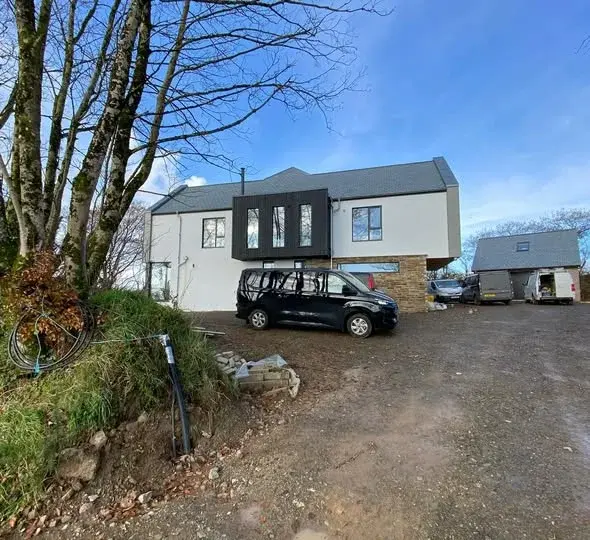
Rendering your house is generally considered a change to the exterior material, which typically falls under Permitted Development rights. This means most homeowners don't need planning permission to render their property.
That said — “generally” is doing a lot of work in that sentence. There are several situations where permission is required, and in some of those situations the consequences of getting it wrong are serious.
Listed buildings
This is a criminal matter. Rendering a listed building without Listed Building Consent is a criminal offence under the Planning (Listed Buildings and Conservation Areas) Act 1990. It can result in prosecution, fines, and a requirement to reinstate the original appearance at your own cost.
If your property is listed — Grade I, Grade II*, or Grade II — you need to contact your local planning authority before doing anything to the exterior. For older stone properties in Cornwall, breathable lime render is almost always the appropriate system if permission is granted, but it must go through the proper process first.
You can check whether a property is listed on the Historic England National Heritage List for England (historicengland.org.uk).
Conservation areas in Cornwall
Cornwall has significant conservation areas — Stratton's historic core, parts of Launceston, Camelford town centre, Bude's seafront streets and many others. In these areas, changing the external appearance of a building — including adding render to an unrendered property — may require planning permission.
The rules in conservation areas aren't just about whether you can render — they can also specify the type and colour of render permitted. Modern through-coloured silicone systems in bright white are sometimes considered out of character with a conservation area's historic appearance.
What to do: if your property is in a conservation area, contact Cornwall Council's planning department before starting. Their Conservation Officer can tell you what's needed and what systems would be considered appropriate.
Article 4 directions
Some areas have Article 4 Directions — planning designations that restrict what Permitted Development allows. These effectively require planning permission for things that would normally be exempt. They're not common on individual residential properties, but they do exist in certain villages and historic areas.
Your local planning authority can tell you whether any Article 4 Direction affects your property. It's a two-minute check on Cornwall Council's online planning constraints map.
Flats and shared buildings
Rendering a flat or maisonette — particularly where it affects the external appearance of a shared building — may need planning permission. There may also be leasehold or freeholder consent requirements separate from planning. If in doubt, check with your building's management company as well as the planning authority.
What about EWI and Building Regulations?
External Wall Insulation (EWI) is a bit different from standard rendering because it adds thickness to the walls and affects the thermal performance of the building. Depending on the system and the property type, EWI may require Building Regulations approval rather than (or in addition to) planning permission.
Building Regulations approval ensures the system is installed to the correct standard for fire performance and thermal performance. It's not the same as planning — it's about technical compliance, not visual impact. For most residential EWI jobs, this involves notifying Building Control and having the work signed off.
Our practical checklist
For most straightforward rendering jobs on standard houses in Cornwall and Devon, no permission is needed. But if any of the following apply, make a quick call to your local planning authority before booking a renderer:
- →Your property is listed
- →Your property is in a conservation area (check on Cornwall Council's planning map)
- →Your property has conditions from a previous planning permission
- →You're rendering a block of flats or a property with shared ownership
- →You're planning EWI and aren't sure about Building Regs
- →You're proposing a colour or finish that's noticeably different from neighbouring houses
Cornwall Council planning can be reached on 0300 1234 151. Holsworthy and Bideford properties fall under Torridge District Council (01237 428700). A five-minute call can save a lot of headaches.
Got a job in mind?
Call us on 07761 735022 or message on WhatsApp. Once you've confirmed you don't need permission (or got it), we're happy to come and take a look. We cover Bude, North Cornwall, and North Devon.
Related articles
Written by the PureRend team — plastering and rendering specialist in Bude, Cornwall. This article is for general guidance only — always verify the rules with your local planning authority.