
External Wall Insulation: Is It Actually Worth It in Cornwall?
EWI is a significant investment and we won't pretend otherwise. The question is whether it pays its way over time — and in Cornwall, on the right kind of property, the answer is usually yes. Here's how it stacks up, and the things we talk through with customers before they commit.
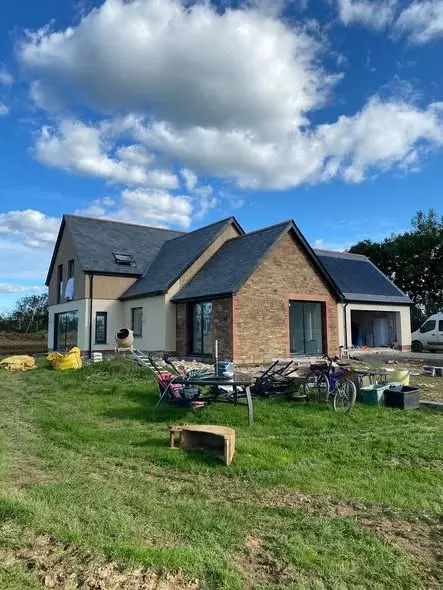
What is external wall insulation?
External wall insulation — EWI — is a system where you fix rigid insulation boards to the outside of your walls and then finish over the top with a render system. The most common insulation is EPS (expanded polystyrene) or mineral wool, at thicknesses ranging from 60mm to 150mm depending on the target U-value and the budget. The render finish is typically silicone, which means a through-coloured, hydrophobic surface that doesn't need painting.
The whole system wraps the building in a continuous layer of insulation. Unlike internal wall insulation — which takes floor space, causes condensation issues at the insulation edge, and requires redecoration — EWI doesn't disturb the inside of the house at all. You live there throughout. You also get a fresh external finish as part of the package, which is part of why a lot of people do it when their render is coming to end of life anyway.
How much heat are solid walls losing?
In a solid-wall property — and that covers most pre-1919 Cornish cottages and terraces — roughly 35% of the heat you generate escapes through the walls. That's not a marketing number; it's the standard energy assessment figure for uninsulated solid masonry. Cavity walls with insulation have a U-value around 0.3 W/m²K. An uninsulated solid stone or brick wall is typically 1.7 to 2.1 W/m²K — five to seven times worse.
Adding 100mm of EPS insulation brings that wall down to around 0.3 W/m²K — equivalent to a cavity wall. The fabric of the building stops being the weak point. When walls account for around a third of a home's heat loss, cutting that out makes a real dent in what it costs to keep the house warm. It's not the whole story — houses also lose heat through roofs, floors and windows — but the walls are usually the biggest single weakness on a solid-wall property.
What it does to your heating bills
The saving varies a lot depending on the size of the property, how it was heated before, and what energy prices do over time. A typical three-bedroom solid-wall Cornish cottage sees a noticeable drop in heating bills after EWI, based on the energy assessments we've seen on jobs we've been involved with. Larger detached properties with more external wall area see bigger savings again.
There's also the comfort factor, which doesn't show up directly in a bill. Cold walls create cold radiant surfaces — the room feels colder than the air temperature because you're radiating heat toward a cold wall. After EWI, the internal wall surface temperature rises, and rooms feel warmer at a lower thermostat setting. A lot of customers report this as the most noticeable change. Damp patches on internal walls often disappear too, because the wall is warmer and condensation no longer forms.
What affects the cost
We won't give you a number without a survey, because the cost varies significantly with wall area, access requirements, window reveals, and the finish chosen. Every EWI job is quoted individually after we've seen the property — it can't be costed reliably from photos or a postcode.
The quote breaks down into the insulation boards and fixings, the basecoat, mesh reinforcement, primer and silicone topcoat, and the labour — EWI is a skilled job with multiple stages and it takes time to do properly. Quotes that come in suspiciously low are usually cutting corners on insulation thickness, mesh specification, or prep.
It's also worth knowing that if you were going to rerender anyway, you're already paying for the render portion. EWI adds to that, but the extra for adding insulation is smaller than the headline figure suggests — you're only paying once for the scaffolding, prep, and finish.
Payback: the honest picture
On energy savings alone, EWI pays back over a number of years rather than overnight — and we'll be straight about that. If you're planning to sell in a couple of years, the case for EWI on heating savings alone is weak. Where it makes sense is as a long-term improvement to a house you intend to keep.
The fuller picture includes EPC improvement. A solid-wall cottage might sit at EPC band E or F. EWI commonly pushes it to C or D, sometimes B. That matters for mortgage rates — green mortgage products offer meaningfully lower rates on Band C and above — and it matters for saleability as energy efficiency requirements tighten. Rental properties will need to meet minimum EPC standards in the coming years. The value of EPC improvement is harder to put a precise number on, but it's real.
Does Cornwall's climate make it more or less worthwhile?
More worthwhile, actually — though not for the reason most people assume. People sometimes think Cornwall's mild winters mean less need for insulation. But Cornwall's winters are not mild in the way that matters for heating. They're wet, damp, and persistently cold — not Arctic, but grey and drizzly for months. The cold damp air strips heat from solid walls very effectively. That means the insulation is working hard through a long season, not just a few sharp frost weeks.
Cornwall's stock of pre-1919 solid-wall properties is also proportionally large compared to the national average. A lot of the county is built in uninsulated stone — cottages in villages from Bude to St Just to Bodmin that were built before cavity wall construction became standard. These buildings are the ones that benefit most from EWI.
The render finish on an EWI system also performs better in Cornwall's wet climate than a painted wall or traditional cement render. A silicone topcoat handles the driving rain off the Atlantic without absorbing moisture, which matters when you're wrapping a building in insulation that you don't want to get wet.
Who EWI is right for
- →Pre-1919 solid stone or brick wall properties — cottages, terraces, farmhouses
- →Properties where the existing render is failing and rerendering is already on the agenda
- →Long-term homeowners who will benefit from a 15–20 year payback
- →Landlords needing to improve EPC ratings ahead of minimum standards requirements
- →Anyone on an inefficient heating system (older oil or electric) where the wall loss is a large proportion of the bill
- →Holiday let owners who want lower running costs and a fresh external appearance
EWI is not right for a listed building or a property in a conservation area where the external appearance is protected — you'd need planning permission and it's often refused. It's also not the right call on a cavity-wall property that already has cavity fill insulation and is relatively well insulated through other means. The return is best where the existing thermal performance is worst.
Our honest verdict
On the right property — a solid-wall Cornish cottage, a long-term owner, an existing render that needs replacing — EWI is one of the most sensible things you can do to a house. The payback period is real and it's not short, but the combination of lower bills, improved comfort, better EPC, and a fresh external finish that won't need maintaining for 25 years is hard to argue with.
If you're thinking about it, get a proper survey done and look at the actual wall area and current energy use rather than relying on generic figures. We can walk around a property and give you a realistic picture of what the EWI cost would be and what improvement to expect. That conversation is free.
Got a job in mind?
Call us on 07761 735022 or message on WhatsApp.
Related articles
Written by the PureRend team — plastering and rendering specialist in Bude, Cornwall.